 P-51D-20-NA "Ridge Runner" flown by Major Pierce W. McKennon, the commander of 335th FS,4th FG, 8th AF at Debden, Essex, England. He scored 12 victories.


 P-51D-20-NA "Ridge Runner" flown by Major Pierce W. McKennon, the commander of 335th FS,4th FG, 8th AF at Debden, Essex, England. He scored 12 victories.
 Fuerza Aerea Venezolana, Grupo Caza 16, Base Aerea El Libertador, Maracay, Palo Negro, Venezuela 2005.
 The Venezuelan Air Force, purchased 24 Blocks 16 fighters ( 18 F-16A and 6 F-16B) with initial deliveries arriving in 1983.
 The Venezuelan F-16s jets in service up to that time were painted in a four-color camouflage scheme. The bottom surface were painted in overall gray FS 36559, a pale gray on the warm side of neutral.
 The top surface were painted in a disruptive of tan FS30219, greenFs34102, and dark green Fs34052. The radome is in the usual neutral gray FS36270.


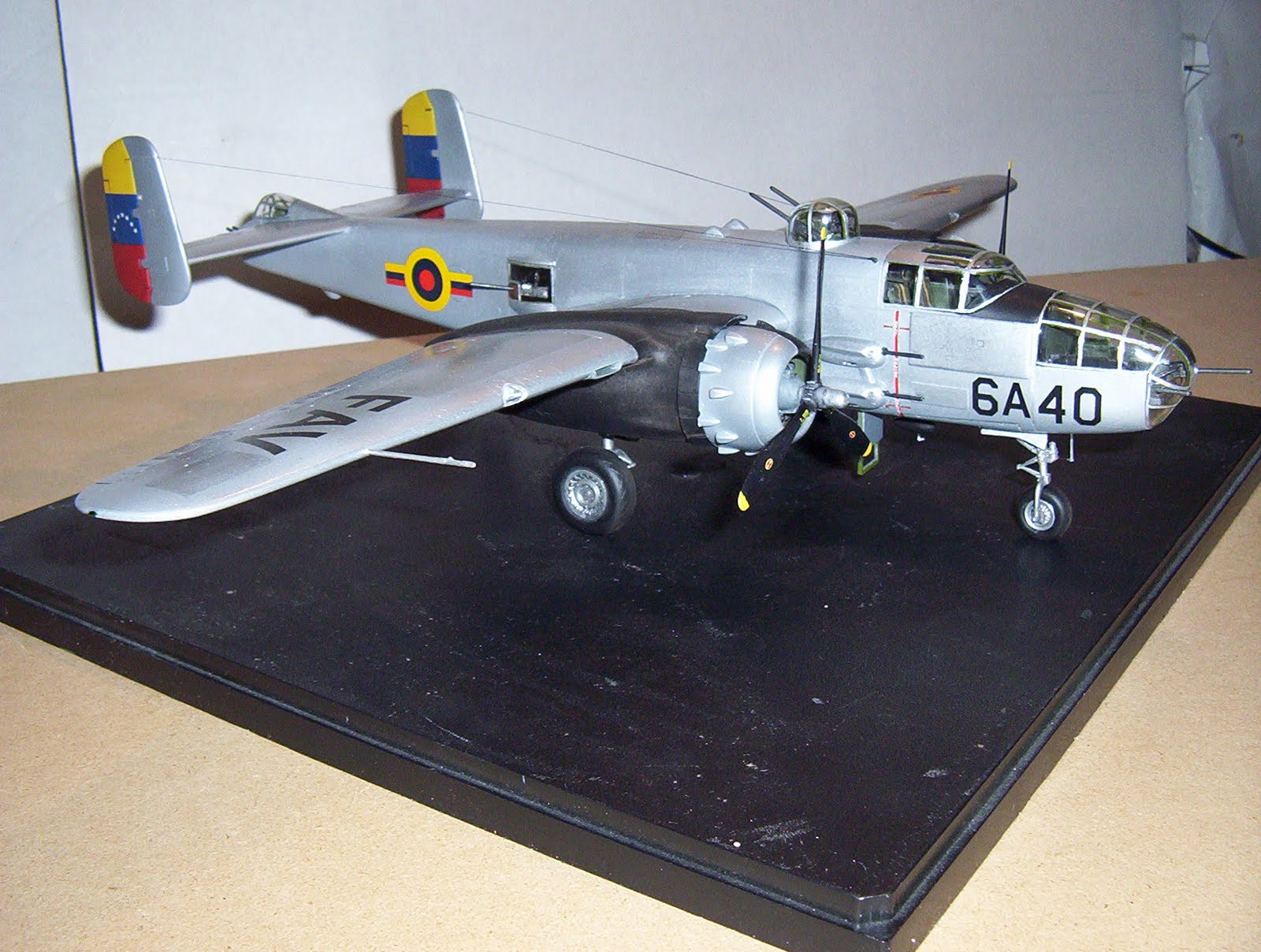


 Colors: Gray Primer ALC 302, AlcladII White Aluminium Alc-106 and Aluminum ALC-101, Tamiya X-11 Chrome Silver, Tamiya XF-16 Flat Aluminum, Tamiya X-32 Titanium Silver, Tamiya XF-1 Flat Black,Model Master Medium Sea Gray.


Between 1941 and 1945, Venezuela received 6 AT-6C and 14 AT-6D which played an important role in national defense at the time of the Second World War. Several of these aircraft were artillery rounds from 7.62 and small loads for coastal patrol aircraft along with other Venezuelan Military Aviation. Although the US retired the AT-6 from active duty by the end of the 1950's, several nations, including Brazil, China, and Venezuela, utilized "the pilot maker" as their basic trainer well into the 1970's. Today aver 350 T-6 Texans remain in airworthy condition.
During 1946, the Canadian Car and Foundry company developed the Harvard MkIV trainer to the specifications of the AT-6G and produced 285 T-6J under the same design for the USAF Mutual Aid Program. Designated the T-6G, the Texan saw major improvements in increased fuel capacity, an improved cockpit layout, as well as a steerable tail wheel.
On November 03, 1946 the Venezuelan Air Force reached 12 T-6G Texan U.S, brought ona flight from Los Angeles California, to the Air Base Boca de Rio, shipping longer fulfilled by the Venezuelan Air Force to date. Were assigned to the Military Aviation School for training of cadets. These noble apparatus gave way to the t-34 A Mentor and jet Provost Mk.52, being trensferred to No.12 Figther Air Group in 1963 where he met anti-guerrilla missions until it ended its operational life in 1972.
-Function: Basic Training Plane

The Kit used was Monogram 5306 in 1:48 scale.
Decal from Aztec Models.
Colors: AlcladII Aluminium (ALC 101), White Aluminium (ALC 106)
Tamiya colors: Flat Black, Red, Blue, Yellow, Dark Yellow, Khaki.
Model Master Colors: Interior Green, Stell and Gunmetal.

The P-47D was equipped with eight 12.7mm machine-guns, this prototype was able to reach 633km/h. the P-47 came to be used for accompanied the bombers and ground attack missions because of its robustness and its 1ton payload capacity.
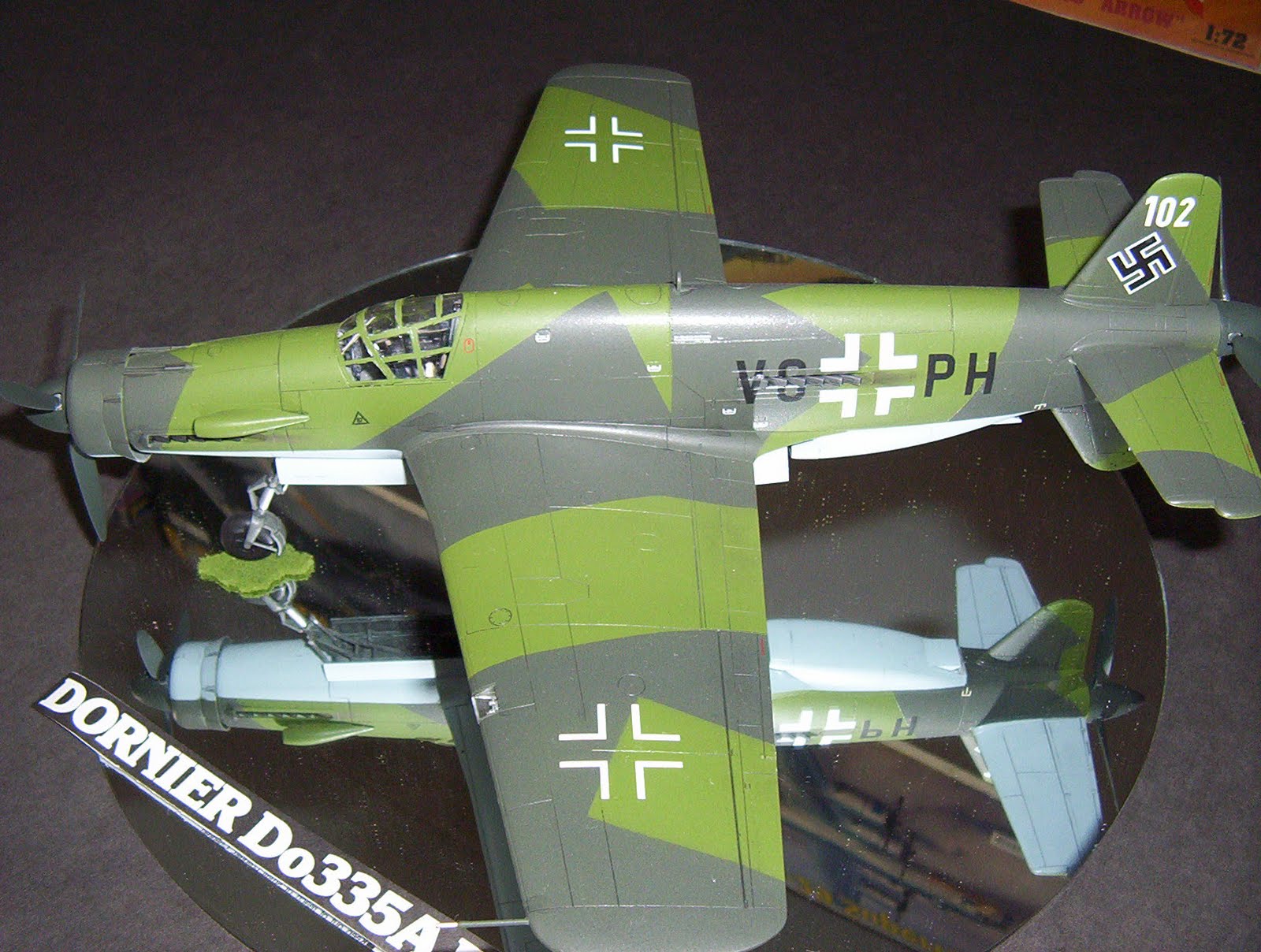 Two 1750hp Daimler Benz 603 engines allowed for a top speed of 750km/h.


 Beginning in 1937, The British Royal Air Force used a two-tone camouflage of Dark Green and Dark Earth on their aircraft upper surface. Beginning in June 1940 a greenish gray color, called Sky, was applied under surface.
 The kit used was Tamiya 1:48 scale
