Monday, November 7, 2011

F-16 A Fighting Falcon Fuerza Aerea Venezolana

Fuerza Aerea Venezolana, Grupo Caza 16, Base Aerea El Libertador, Maracay, Palo Negro, Venezuela 2005.


The Venezuelan Air Force, purchased 24 Blocks 16 fighters ( 18 F-16A and 6 F-16B) with initial deliveries arriving in 1983.


The Venezuelan F-16s jets in service up to that time were painted in a four-color camouflage scheme. The bottom surface were painted in overall gray FS 36559, a pale gray on the warm side of neutral.


The top surface were painted in a disruptive of tan FS30219, greenFs34102, and dark green Fs34052. The radome is in the usual neutral gray FS36270.


In 2005 (20 Anniversary F-16 Vipers in service) the Venezuelan Air Force change the old "tactical scheme" colors, only two of the four colors are different ,the dark green FS- 34079 and pale green FS-34227.


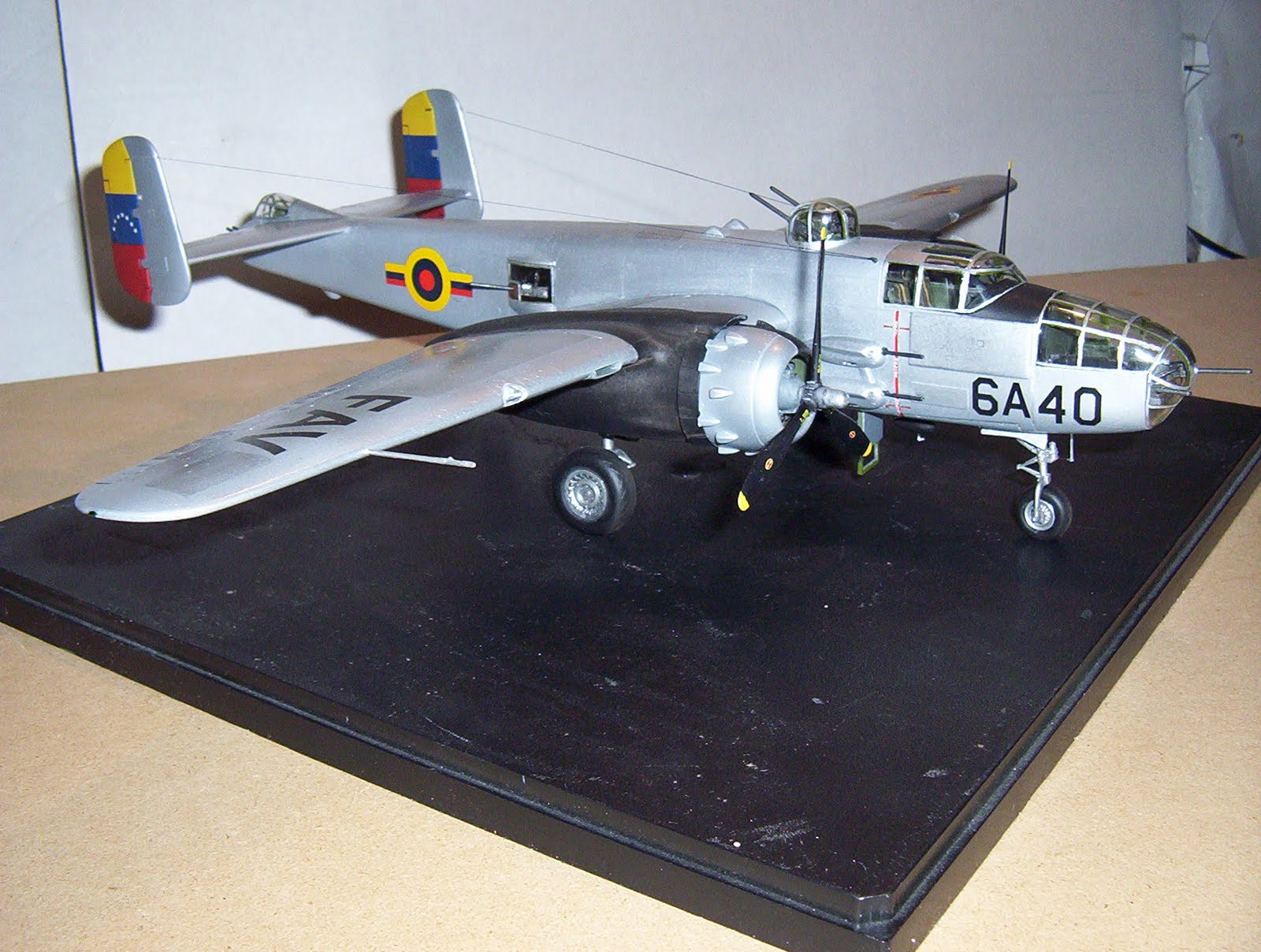
North American B-25 Mitchell Fuerza Aerea Venezolana


Escuadron Bombarderos No.40 Base Aerea Tte. Vicente Landaela Gil, Barquisimeto, Estado Lara 1947-1973.


The Kit I used for this model was Monogram 1:48 Scale, For the Colors I used Alclad II Lacquer (Aluminum ACL 101, white Aluminum ALC 103) , Tamiya Colors: Flat black XF-1, Semi Gloss Black X-18,Chrome SilverX-11, Olive Drab XF-62, Flat Red XF-7, Blue X-4 and Models Master Metalizer (Gunmetal and Aluminum Plate), Model master Interior green FS34151,Floquil BNSF Yellow
Decals I used General Venezuelan Air Force from: Aztec Models Mexico.


Tuesday, January 25, 2011

CANBERRA B(I).Mk.8 Venezuelan Style

With the successful flight of the prototype on Friday the 13th 1949, this paved the way for English Electric to move into production of the first Canberra's. The B.2 bomber version came first & entered service with the RAF in the high level bombing role.


The true interdictor version, corresponds to the third generation of the Canberra-based B.Mk.6 with a completely redesigned cabin hunting eccentric type, reduced to two crew members (pilot and navigator-bombardier); avionics and sighting equipment modernized, structural reinforcements and a new hard spot on each wing for bombs of 454kg or SNAB 68mm rocket launchers on the wings.


The B(I).Mk8 was designed for interdiction missions (hence the prefix "I" in the designation) and attacks low-level, highlighting the improped weapons warehouse to support a package of four guns Mk.V 20mm Hispano Suiza carrying 525 rounds per gun and flares to illuminate the target.


The B(I).Mk8 was a popular aircraft with crews despite its obvious shortcomings of having no ejection seat for the navigator.
Venezuela received 30 Canberras, including eight B(I). Mk.8, at the beginning of 1958 arrived in the Venezuelan Air Force eight individuals, who were assigned to B-Bomber Squadron 39 in Barcelona. In 1977 are updated in the UK changing its name to B(I),Mk,88. The las four were kept in service in the 1980 along with other versions of Canberras after a long life in the Venezuelan Air Force, this aircraft 4B39 was retired on September 16, 1990 after 37 year of service.


. Function: Aircraf interdiction and ground attack


.Source: Unite Kingdom.


.Crew: Two: pilot and navigator-bombardier


.Dimensions: Length: 19.96m, Wingspan:19.49m, Height: 4.75m


.Weights: Empty: 10509kg; Loaded: 25514kg.


.Powerplant: Two Rolls-Royce Avon RA.7Mk109 power from 3401kg


.Performance: Maximum speed:933km/h, Maximum range:5471km, Autonomy combat: 1300km, service ceilling 15000


.Armament: four guns Package Mk.V Hispano Suiza 20mm with 500 rounds per gun, 3628kg of weapons and two hard points on the wings, range of bombs: 454,227,113 and 45 kg; rocket SNAB of 18x68mm.


The model is a 1:48 scale kit manufactured by AirFix (A10102) It is known by modelers a good kit, the instruction are easy to understand, I didn't use the kit decal on this project, I use decals from Latinamerican Canberras 2 multi scale set manufactured by Aztec of Mexico.
Colors: Gray Primer ALC 302, AlcladII White Aluminium Alc-106 and Aluminum ALC-101, Tamiya X-11 Chrome Silver, Tamiya XF-16 Flat Aluminum, Tamiya X-32 Titanium Silver, Tamiya XF-1 Flat Black,Model Master Medium Sea Gray.

B(I) Mk.88 (Mk.8) Venezuelan Air Force ( FAV 4B39) , 39th, Squadron. Barcelona 1958.


Friday, January 21, 2011

North American T6-C/D / T-6G Texan Venezuelan Style.

The North American T-6 Texan was known as "the pilot maker" because of its important role in preparing pilots for combat. Derived from the 1935 N. American NA-16 prototype, a cantilever low-wing monoplane, the Texan filled the need for basic combat trainer during WWII and Beyond.


Between 1941 and 1945, Venezuela received 6 AT-6C and 14 AT-6D which played an important role in national defense at the time of the Second World War. Several of these aircraft were artillery rounds from 7.62 and small loads for coastal patrol aircraft along with other Venezuelan Military Aviation.


Although the US retired the AT-6 from active duty by the end of the 1950's, several nations, including Brazil, China, and Venezuela, utilized "the pilot maker" as their basic trainer well into the 1970's. Today aver 350 T-6 Texans remain in airworthy condition.
During 1946, the Canadian Car and Foundry company developed the Harvard MkIV trainer to the specifications of the AT-6G and produced 285 T-6J under the same design for the USAF Mutual Aid Program. Designated the T-6G, the Texan saw major improvements in increased fuel capacity, an improved cockpit layout, as well as a steerable tail wheel.


On November 03, 1946 the Venezuelan Air Force reached 12 T-6G Texan U.S, brought ona flight from Los Angeles California, to the Air Base Boca de Rio, shipping longer fulfilled by the Venezuelan Air Force to date. Were assigned to the Military Aviation School for training of cadets. These noble apparatus gave way to the t-34 A Mentor and jet Provost Mk.52, being trensferred to No.12 Figther Air Group in 1963 where he met anti-guerrilla missions until it ended its operational life in 1972.


-Function: Basic Training Plane

-Source: United States.
-Crew: Pilot and Student
-Dimensions: Length: 8.83m, Wingspan:12.81m, Height: 3.57m
-Weights: Empty: 1823Kg, Maximum takeoff: 2381Kg.
-Power Plant: One Pratt&Whitney radial engine R-1340-49 Wasp of 600 hp.
-Perfomance: Maximum speed:338Km/h, Cruising speed: 233Km/h, Maximum range: 1191Km; Ceiling: 7400m.
-Armament: Two hard points on each wing for unguided rockets and .30 caliber machine gun pod.


The Kit used was Monogram 5306 in 1:48 scale.
Decal from Aztec Models.

Colors: AlcladII Aluminium (ALC 101), White Aluminium (ALC 106)
Tamiya colors: Flat Black, Red, Blue, Yellow, Dark Yellow, Khaki.
Model Master Colors: Interior Green, Stell and Gunmetal.


Friday, January 7, 2011

Republic P-47D Thunderboldt "RAZORBACK"

The P-47D was equipped with an R-2800-59 engine featuring a water injection system, and could generate up to 2300hp in emergency combat scenario. The first versions were caller "Razorback", because of their sharp-edge dorsal fin running from the canopy to the upper fuselage.


The P-47D was equipped with eight 12.7mm machine-guns, this prototype was able to reach 633km/h. the P-47 came to be used for accompanied the bombers and ground attack missions because of its robustness and its 1ton payload capacity.


The Kit used was ARII Plastic Model 1/48 scale.

Saturday, November 20, 2010

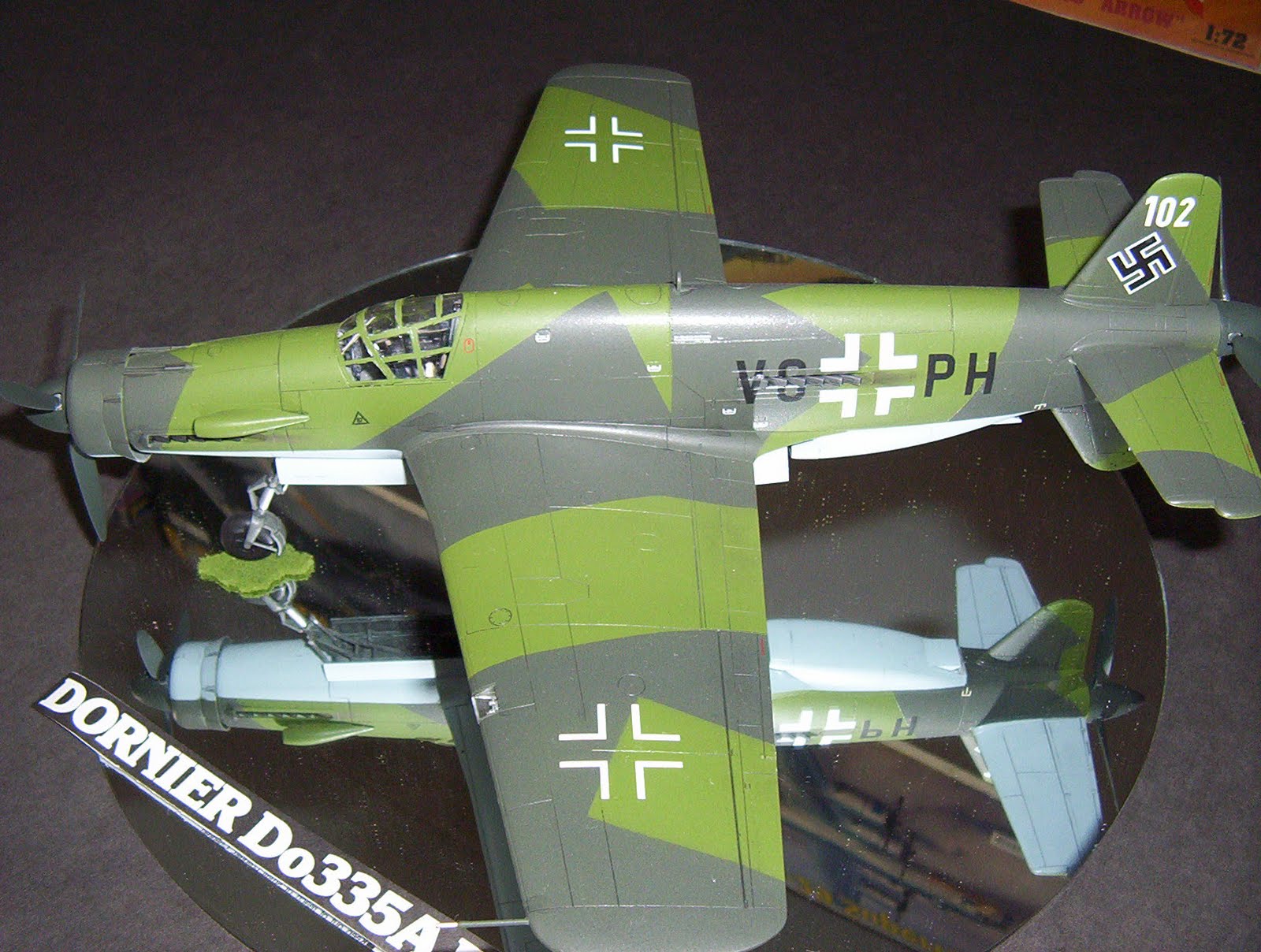
DORNIER Do335A PFEIL


The Dornier Do 335A Pfeil ( Arrow) was one of the most unusual fighters of the Luftwaffe's, its most salient characteristic was the tractor/pusher, two propeller combination, but the cross-shaped tail and forward positioned landing gear also contributed to its unique appearance.
Two 1750hp Daimler Benz 603 engines allowed for a top speed of 750km/h.

The Do335 had one 30mm machine gun in the axis of the nose propeller and two 20mm machine guns over the engine. The fighter/bomber could carry up to 1000kg of bombs.

The top surface was camouflaged in a dark green - green/yellow and underside
was finished in light blue. In July 1944, the Air Ministry issued instructions to change the top camouflage to RLM81 brown-violet and RLM82 light green
.
1:48 scale Tamiya Kit. Do335 A-0W. Nr.240102.

Friday, November 19, 2010

Supermarine Spitfire MkI

The Supermarine Spitfire attained a top speed of 586 Km/h. Using the famous Rolls-Royce Merlin, liquid cooled 12 cylinder engine that produced more than 1000 horsepower. The MkI Spitfire was armed with eight 7.7mm machine guns.
Beginning in 1937, The British Royal Air Force used a two-tone camouflage of Dark Green and Dark Earth on their aircraft upper surface. Beginning in June 1940 a greenish gray color, called Sky, was applied under surface.


The kit used was Tamiya 1:48 scale


Sunday, November 15, 2009

P-51 Mustang Collection.


P-51 B-5-NA MUSTANG.

Shangri-La flown by Captain Don S. Gentile,
4th FG, 336th FS, 8th Af at Debden, Essex, England in April,1944.
He scored 21.84 victories.
Model kit Tamiya 1:48 scale.


RAF MUSTANG III

FB387 No 315 (Polish) Squadron
Model kit Tamiya 1:48 scale.


P-51 D-10-NA MUSTANG.

Petie 2nd flown by Lieutenant Colonel John C. Meyer,

352nd FG, 8th AF at Asche, Belgium on January 1, 1945.
He scored 24 victories in WWII
Model kit Tamiya 1:48 scale.

Saturday, November 14, 2009

Chance Vought F4U-1 Pacific War, Collection.


Chance Vought F4U-1/2 Bird Cage Corsair
VMF (N)-532 (Marine Corps)
Tamiya Kit
1:48 Scale


Vought F4U-1A Corsair
VF-17, No.1 "BIG HOG", Ondonga, November 1943.
Tamiya Kit
1:48 Scale


Vought F4U-1D Corsair
VF-84, wing 167, Carrier Bunker Hill 1945, Feb.
Tamiya Kit
1:48 Scale